Vertex - Complete Guide to the Digital Box Compression Tester: Importance, Working Principle, and Applications
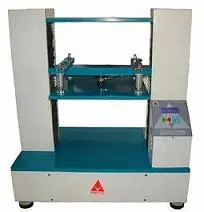
When shipping products globally or storing inventory in massive warehouses, packaging integrity is everything. A collapsed box during transit doesn't just mean a damaged product; it means unhappy customers, financial losses, and compromised brand reputation.
How do manufacturers ensure packaging can withstand the harsh realities of stacking and transportation? The answer lies in a crucial testing instrument: the Digital Box Compression Tester.
What is a Digital Box Compression Tester?
A Digital Box Compression Tester is a precision laboratory instrument used to measure the compressive strength and load-bearing capacity of packages such as corrugated boxes, shipping containers, honeycombs, wooden crates, drums, cans, and pails.
Manufactured to meet stringent international standards (such as ASTM D642, TAPPI T804, and IS 7028), this machine evaluates how much external compressive load a container can endure before failing or deforming.
Vertex Machines offers advanced models (D3-5K with a 500 kgf capacity and D3-10K with a 1000 kgf capacity) featuring microprocessor-based controls, digital readouts, and PC interface software for seamless data analysis and graph generation.
How Does a Box Compression Test Work?
The working principle of a Box Compression Tester is straightforward yet highly precise. It replicates real-life stacking pressures experienced in warehouses and transit vehicles.
- Sample Placement: The test sample (an empty or filled corrugated box, with or without closures) is placed centrally between two rigid, parallel platens of the machine.
- Controlled Compression:Driven by an electro-mechanical servo motor and ball-screw mechanism, the top platen moves downward at a constant, standardized rate (typically 12.5 mm / 0.5 inches per minute), as specified by testing standards.
- Data Logging: As the package compresses, high-precision load sensors and displacement scales measure the exact force applied versus the deformation.
- Key Test Results: The test concludes when the box reaches its breaking point, yielding critical outputs:
- Peak Load: The maximum compressive strength the box can handle.
- Deformation at Peak Load: How much the box compressed before collapsing.
- Critical Load Thresholds: Determining headroom limits to safeguard internal contents.
Key Features of Vertex Digital Box Compression Testers
- Microprocessor Control: Sophisticated electronic controls ensure high accuracy and effortless operation.
- Direct Digital Readout: Bright LCD displays show real-time compressive strength with a separate peak-hold function.
- Non-Resonant Drive: Ball-screw driven frictionless movement paired with a servo motor makes the machine virtually noise-free.
- Safety Features: Includes over-travel protection and pre-selected load termination to prevent total destruction of reusable boxes during threshold testing.
- PC Integration: Built-in RS232/USB interfaces allow seamless transfer of test data to custom report-generation software complete with graphical analysis.
Which Industries Use Box Compression Testing?
Packaging durability is vital across multiple sectors. Industries that heavily rely on Digital Box Compression Testers include:
- E-Commerce & Logistics: Ensuring shipping cartons survive multi-tier stacking in delivery trucks and sorting hubs.
- FMCG & Food and Beverage: Testing secondary packaging for canned goods, beverage bottles, and consumer boxes.
- Pharmaceuticals & Healthcare: Protecting fragile medicine bottles, vials, and medical kits from crushing forces.
- Electronics: Ensuring appliance and gadget packaging absorbs vertical shocks during warehousing.
- Chemical & Industrial Manufacturing: Evaluating heavy-duty containers, fiber drums, and pails.
How it Works
Frequently Asked Questions (FAQs)
Q1. What is the primary purpose of a Box Compression Tester?
Ans: The primary purpose is to measure a package's ability to resist external compressive loads during storage and transit. It serves as an index of the overall quality of the box's material and structural workmanship.
Q2. Can I test both empty and filled boxes on this machine?
Ans: Yes. The test can be conducted on empty or filled boxes, with or without box closures, depending on your specific quality control requirements.
Q3. What standards do Vertex Box Compression Testers comply with?
Ans: Vertex machines comply with major national and international standards, including IS 7028 (Part VI & IX), ASTM D4577 / D642, TAPPI T804, FEFCO TM 50, and FCBM 14:96.
Q4. How do I get test reports from the machine?
Ans: The machine features a built-in PC interface (RS232/USB) and dedicated data analysis software. It automatically compiles your test data, generates comprehensive reports, and plots force vs. deformation graphs.
"Trusted by 500+ Quality Control Professionals across India."
Phone: +91-9323405785
Email: info@vertexmachines.com